


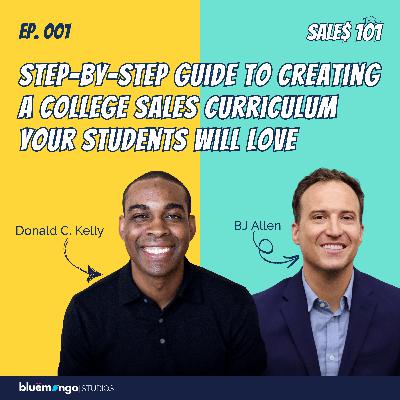
Step-by-Step Guide to Creating a College Sales Curriculum Your Students Will Love | Donald Kelly and BJ Allen - 01
Description
Have you ever tried to create a courseware for a sales class and just felt like you had no clue what to do? Today, we’re going to share some of the mistakes that we made and how you can avoid them.
The Horrors of Starting a Sales Curriculum
· Sales leaders and professors are always stuck with one question when building their first curriculum: Where do you even start?
· How do you find that perfect balance between a traditional classroom or university learning style and sales, which is such an applied discipline?
· We both share our stories about developing our first sales curriculum for our college students.
· Our experience also helped us notice the mistakes other sales professors were making.
· The common course development mistakes we saw were: trying to cover too much content, creating too many unstructured assignments, and lacking an efficient grading system.
Four Steps to Building a Sales Curriculum
· Make sure you have a pen and paper ready. We go into the details of each of these steps and the resources that will help you build your sales curriculum.
1. Define Your Course’s Focus: You need to know what job role you’re preparing your students for. Are you teaching future entry-level sellers, Business Development Representatives (BDRs), Sales Development Representatives (SDRs), account managers, or something else?
· Narrowing this down will help you know what personal experiences you should share and what your core course subjects should be.
2. Choose Your Sales Process: Is there a specific process, methodology, or widely recognized industry resource that you use to structure your course? A logical progression is essential.
· Sales is a highly applied discipline, and most students taking an intro class don’t even know what professional selling really is. Throwing every possible approach or concept at them at once actually does more harm than good.
· Instead, picking a foundation—whether it’s a sales method like Challenger, SPIN, Sandler, or a structured process laid out in a well-regarded textbook—helps you guide students step by step. Each week or module builds on the last, creating continuity and a “map” students can follow.
3. Integrate Learning into the Real World: Consider how to bring the realities of sales into the classroom.
· Figure out what tools, scenarios, or voices you’re going to use to teach your students. For example, we created a simulation to go along with our textbook, designed assignments on how to use specific tools such as Apollo, and invited industry experts to share their knowledge with our students.
4. Make Grading Efficient for You: Design your grading and assignments so your students will know what’s expected. But also tailor it to how you can save time.
· Do this by using clear rubrics, integrating assignments, getting help from TAs, and leveraging automation when you can.
"You can't teach everything in one classroom." - BJ Allen.
“It’s tough being able to take 15 - 20 years of experience and give it all to a student. It’s not wise to teach them everything at once, as they won’t be able to absorb it all. They just need enough to get to the next step.” - Donald Kelly.
Resources
· Get your copy of Fanatical Prospecting by Jeb Blount.
· Connect with Donald Kelly and BJ Allen on LinkedIn. Be sure to reach out for feedback or help with your own curriculum.
· Visit the show’s Substack for additional resources and downloads.





 United States
